
Introduction
It's 9:15 a.m. and circle time is starting. One child points to a picture schedule to see what's next. Another taps a communication board to request a turn with the felt board. A third quietly heads to a soft corner with headphones before rejoining the group.
None of this is unusual. It's just how the room works.
Many preschool teachers struggle with a real tension: how do you meet wildly different needs without singling anyone out? An inclusive classroom welcomes children with different abilities, communication styles, sensory profiles, cultures, and learning paces — without forcing every child into the same mold.
This article covers the core principles behind inclusive design, how to set up a sensory-aware physical space, daily teaching strategies that work across ability levels, and how to build real partnerships with families and specialists.
Key Takeaways
- Inclusion means removing barriers to access, participation, communication, and belonging—not only shared seating.
- Predictable routines, visual supports, and sensory-aware spaces help neurodivergent and neurotypical children alike.
- Pair strengths-based teaching with individualized supports and family input for the strongest outcomes.
- Inclusive design protects dignity and autonomy so every child can engage in play and learning.
What Makes a Preschool Classroom Inclusive?
An inclusive preschool classroom is a shared learning environment where children with and without disabilities learn side by side, with the adaptations and supports each child needs to participate meaningfully. That's the definition used by DEC and NAEYC's joint position statement on early childhood inclusion, which identifies three quality markers: access, participation, and supports.
Equality gives every child the same resources. Inclusion adapts materials, communication, and expectations so every child can reach the same opportunity. A ramp isn't unfair to kids who can walk — it's just the entry point for kids who need it.
Access, Participation, and Support Aren't the Same Thing
A child can be physically present in an activity and still be excluded from it. Consider a child who can roll a ball but can't hear the verbal instructions over classroom noise, or one who's seated at the art table but has no way to request a different color. That's access without participation.
Real inclusion asks three questions:
- Access: Can the child physically reach the materials and space?
- Participation: Can the child engage socially and emotionally, not just academically?
- Support: Does the child have the communication tools, sensory accommodations, or instructional adjustments to actually take part?
Language Matters More Than Teachers Often Realize
Avoid treating disability, neurodivergence, or alternative communication as problems waiting to be fixed. Some families and communities prefer person-first language ("child with autism"); others prefer identity-first language ("autistic child"). Follow the family's lead rather than defaulting to one convention.
The payoff for getting this right extends to the whole class. Research summarized by the University of Colorado Boulder found that typically developing children in inclusive preschools show developmental gains comparable to peers in non-inclusive settings, plus stronger self-control, perspective-taking, and friendship skills.
What Should Inclusion Look Like in Practice?
Picture a group art project. One child speaks to describe what she's building. Another points to picture cards to request more glue. A third watches for a minute before joining in with hand-over-hand support from a peer. All three are participating — just differently.
Attendance alone is not inclusion. A useful test: does the child have a real way to contribute, be understood, and choose how they join — or are they only occupying a seat?
Designing the Physical Environment for Access and Regulation
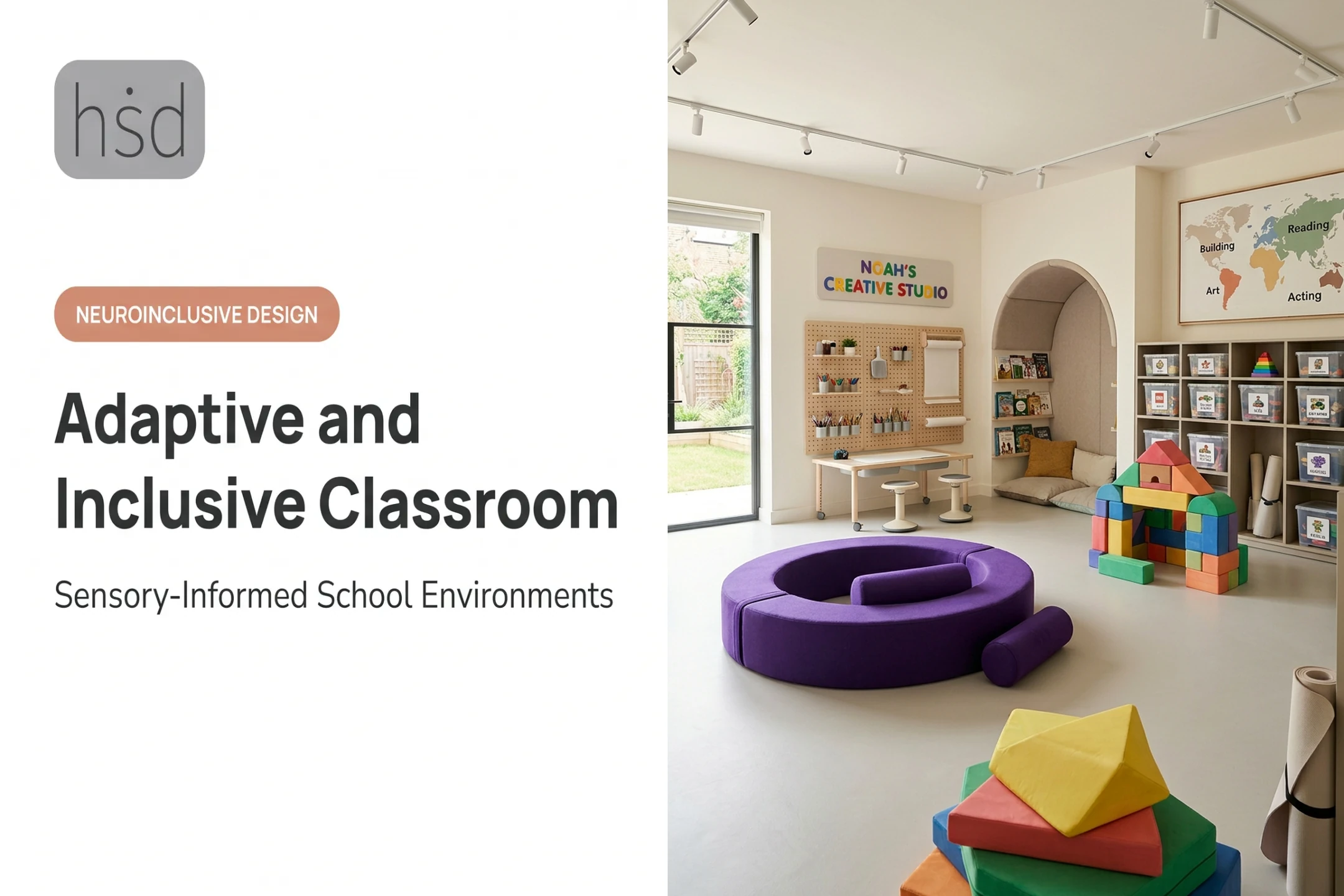
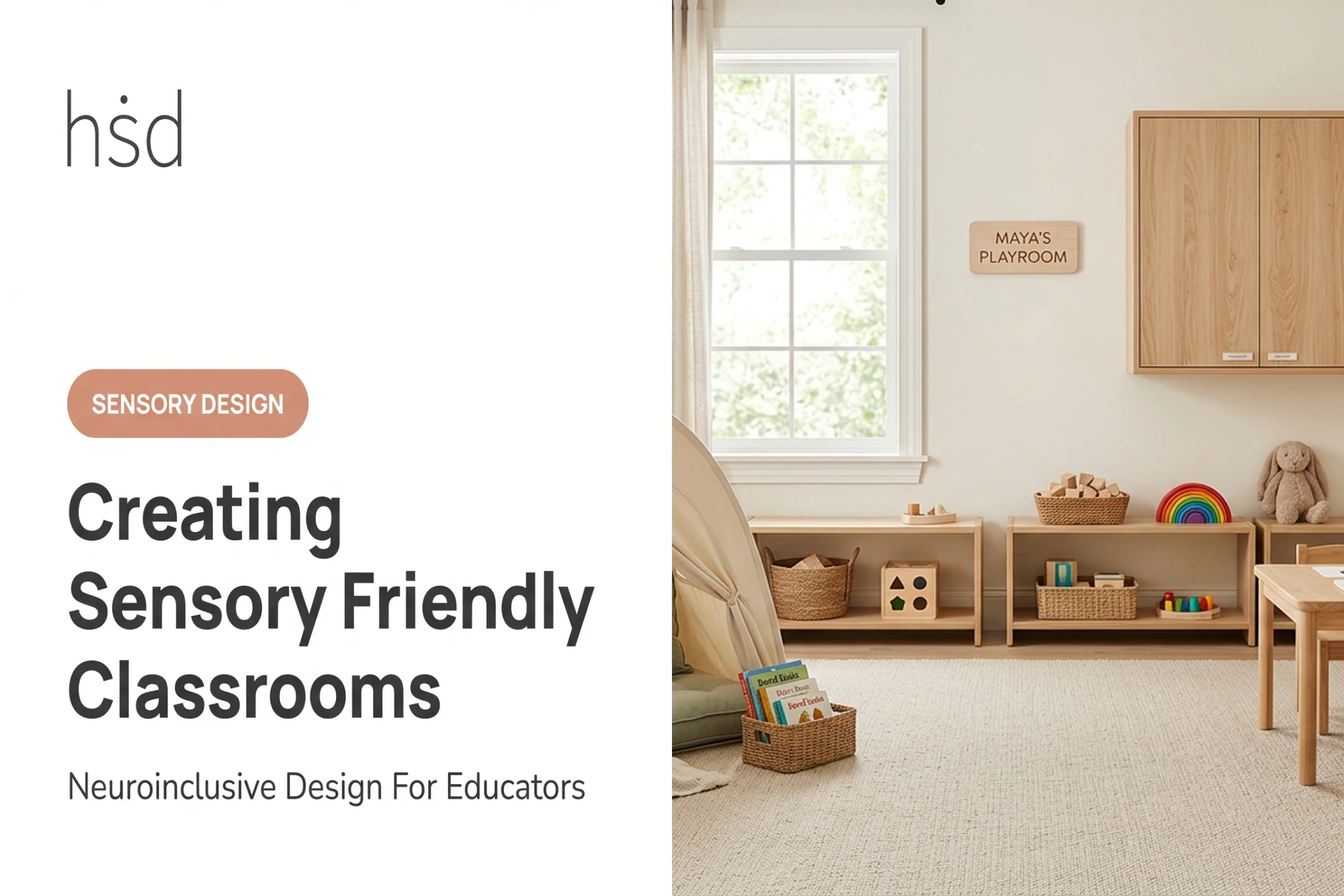
Room layout either removes barriers or creates them. Clear pathways, defined learning zones, accessible storage, and uncluttered surfaces matter for every child, and they're essential for children using mobility or positioning supports.
Sensory conditions deserve just as much attention as layout:
- Reduce echo, background noise, and overlapping audio sources
- Favor controllable daylight over flickering fluorescents, and offer a lower-stimulation lighting option
- Use closed storage, neutral bins, and limited wall displays instead of covering every surface
- Keep pathways wide enough for wheelchairs, walkers, or adaptive seating
Sensory preferences vary child to child. Don't assume. Observe, and ask families what actually helps.
The Calm Corner Isn't a Time-Out Spot
Georgia's Pre-K program defines a calm corner as a safe space available to any overstimulated or dysregulated child, and explicitly not a punishment. A functional version includes:
- Soft seating or a mat
- A few calming sensory tools or books
- Visual emotion cards or a simple breathing prompt
- A visual timer, if transitions back to the group are hard
Teach every child how to use it and when, not just the children flagged for support.
Visual Organization Pays Off Fast
Once the room supports regulation, visual organization helps children move through the day on their own. Picture labels, photo schedules, first-then boards, and transition warnings are among the most cost-effective changes a classroom can make, and they help verbal and non-verbal children equally.
Universal design also means more than one way to join an activity. At the art table, offer a photo model of the finished project plus multiple textures and tools. At snack, pair a picture sequence for each step with verbal instruction.
How Can a School Assess Its Classroom Environment?
Walk the room at a child's eye level. Literally get down there. Note where reach is limited, where noise builds up, where lighting glares, and where a child has no way to retreat if overwhelmed.
Bring those observations to families, special educators, and therapists before making changes. They'll catch things a single walkthrough misses.
A Sensory Environment Assessment maps lighting, ventilation, spatial organization, routines, and accessibility to flag barriers before they become daily meltdowns or disengagement. Highly Sensitive Design conducts these assessments for schools and educational programs, where a fresh, trained eye often spots what staff have stopped noticing.

Inclusive Teaching Strategies for Daily Routines and Play
Predictability is one of the most practical inclusion tools in a preschool classroom. Keep the daily sequence consistent. Pair spoken directions with visual or physical cues. Give advance notice before transitions — a 5-minute warning, then a 2-minute warning — so children can prepare before the shift happens.
Make instructions genuinely accessible:
- Use short phrases, one step at a time
- Demonstrate the action instead of just describing it
- Build in processing time before repeating yourself
- Offer choices rather than single directives
- Use multiple communication modes — speech, gesture, picture, sign
Repeating a direction louder or faster rarely helps. It usually just adds pressure.
Peer Play Needs Structure, Not Just Proximity
Inclusive peer play doesn't happen automatically just because children share a room. Build support into the activity itself:
- Use small groups, defined roles, turn-taking visuals, and peer modeling
- Offer a simple entry script — "Can I play too?" with a picture card — so a child can join without pressure
- Allow observe-first participation when a child needs time before entering play
- Provide alternative materials or a simpler version of the task when needed
Let children show understanding through drawing, gesture, building, or an assistive device — not just spoken answers.
Behavior Is Communication, Not Defiance
Before assuming a behavior is "acting out," check for common triggers: noise, hunger, fatigue, confusing expectations, or a transition that came too fast. Teach a replacement skill — a hand signal for "break," for example — rather than only redirecting the unwanted behavior.
Quick reference across the day:
| Routine | Inclusive strategy |
|---|---|
| Arrival | Visual check-in board, consistent greeting routine |
| Circle time | Visual schedule, choice of seating, fidget option |
| Centers | Picture labels, defined roles, observe-first option |
| Clean-up | Song cue, visual job chart, warning before transition |
| Snack | Picture choice board, "more/all done" signals |
| Outdoor play | Sensory break option, peer-paired activities |
| Dismissal | Countdown visual, consistent closing routine |
Support Communication in Every Routine
Not every child communicates by talking, and that's fine. Picture symbols, choice boards, signs, gestures, and speech-generating devices are all valid. No child should be pressured to speak or use one specific method if another works better for them.
Keep communication tools available everywhere — during play, meals, transitions, and outdoor time, not just during structured lessons. Model their use with the whole class, not only with the child who relies on them. That normalizes the tool instead of spotlighting the child, and it keeps communication support part of the daily routine rather than a one-off accommodation.
Building Consistent Support With Families and Specialists
Families know things no classroom observation ever will: what calms their child at home, how they communicate outside school, what their cultural context is, and what early warning signs of stress look like.
Keep family communication brief but consistent. A quick daily or weekly note covering what worked, what created friction, and what to try next beats a long monthly conference every time.
Coordinated planning across teachers, therapists, and program leaders matters just as much. Set clear privacy boundaries about who is authorized to discuss a child's information. When in doubt, keep that circle small and confirm it with families first.
Treat Inclusion as a Cycle, Not a One-Time Fix
- Identify a specific barrier, not a vague concern.
- Consult the child (when possible) and the adults who know them best.
- Try one modest adjustment.
- Observe how participation changes.
- Revise. Don't assume the first fix is permanent.
That same cycle drives Highly Sensitive Design's neurodivergent consultation work with schools and project teams: inclusive design as ongoing collaboration among architects, educators, and families, not a one-time checklist.

A useful reference point is a public school NEST program, where neurodivergent and neurotypical students share a learning environment with layered supports built in from the start. It shows the approach can scale beyond a single classroom.
Frequently Asked Questions
What are the key principles of an inclusive preschool classroom?
Access, participation, and individualized support, paired with genuine belonging rather than just physical placement. Family collaboration and respect for different communication and learning styles tie it all together.
What is the difference between an inclusive preschool classroom and a regular classroom?
Inclusion is an approach, not a separate classroom type. It adapts the environment, teaching methods, routines, and supports so children with varied needs learn together in one setting.
What are some examples of an inclusive preschool classroom?
Visual schedules, flexible seating, calm spaces, multiple communication tools (speech, signs, pictures, devices), structured peer play, and differentiated activities that let children join at their own level.
How can teachers make a preschool classroom more inclusive?
Start with an environment audit, then build predictable routines, multimodal instruction, and flexible participation options. Pair that with strengths-based behavior guidance and regular check-ins with families.
How do sensory-friendly classroom features support inclusion?
Manageable sound, lighting, and clutter, plus movement and retreat options, reduce the barriers that make it hard for some children to stay regulated. It also stops sensory needs from being mistaken for misbehavior.