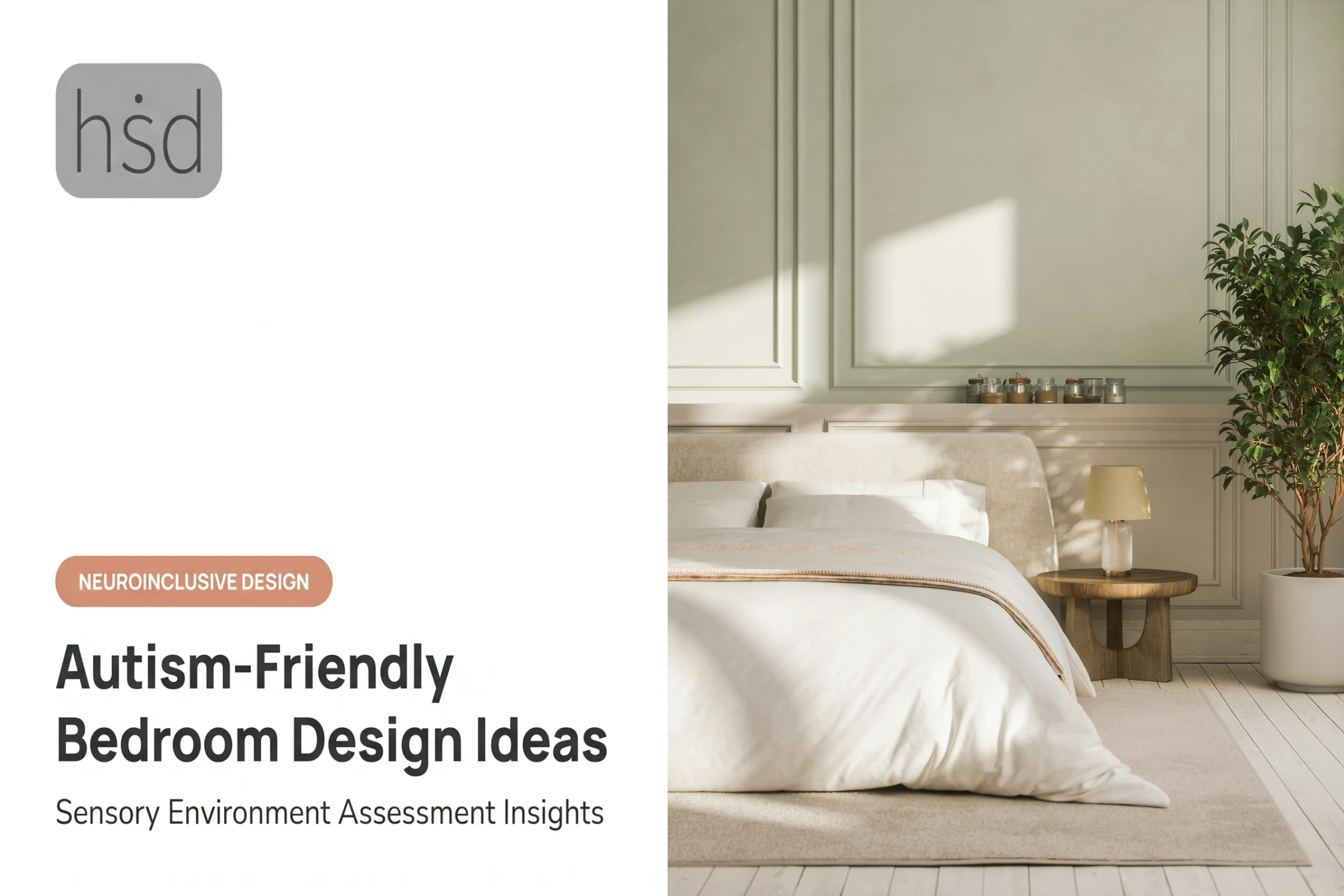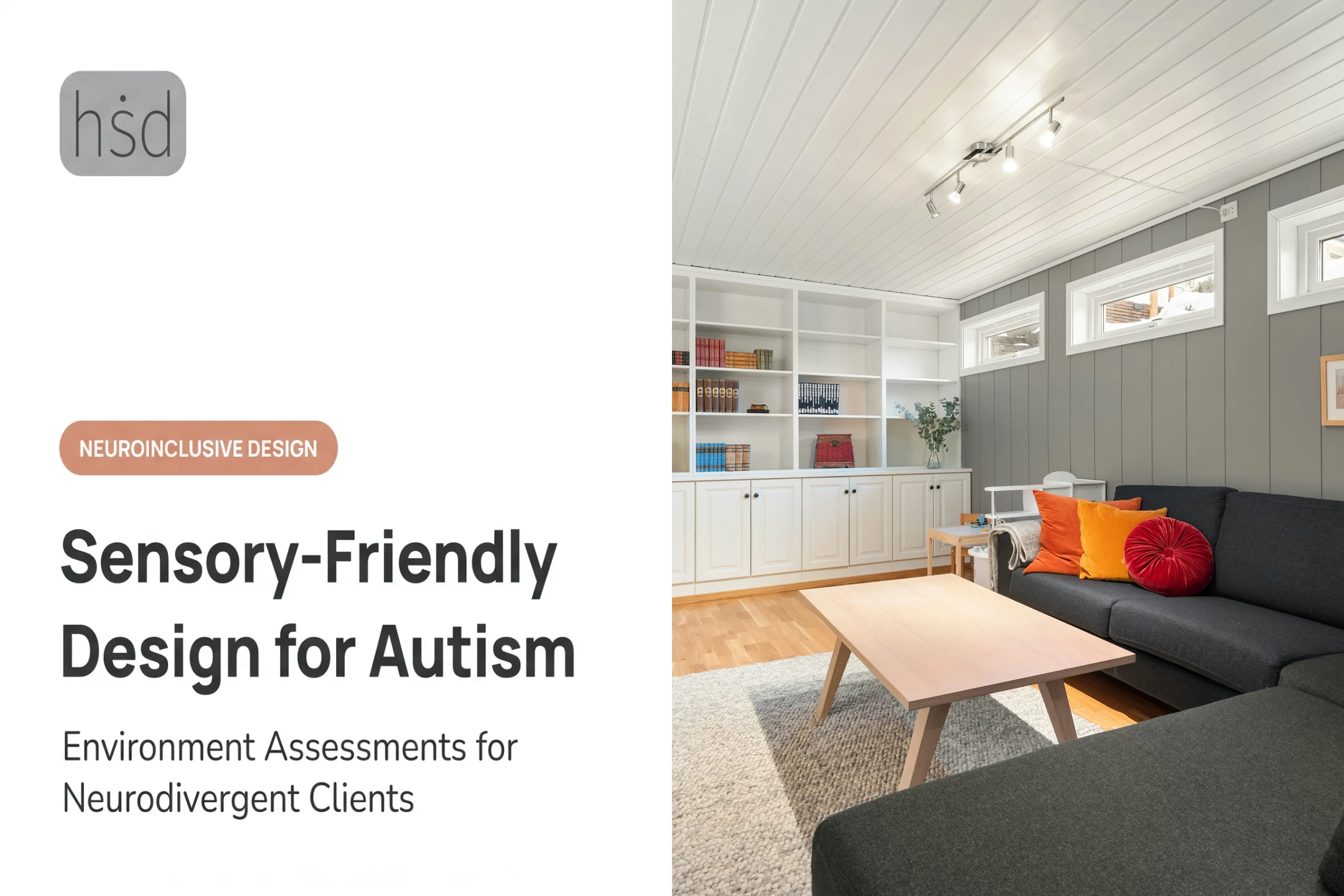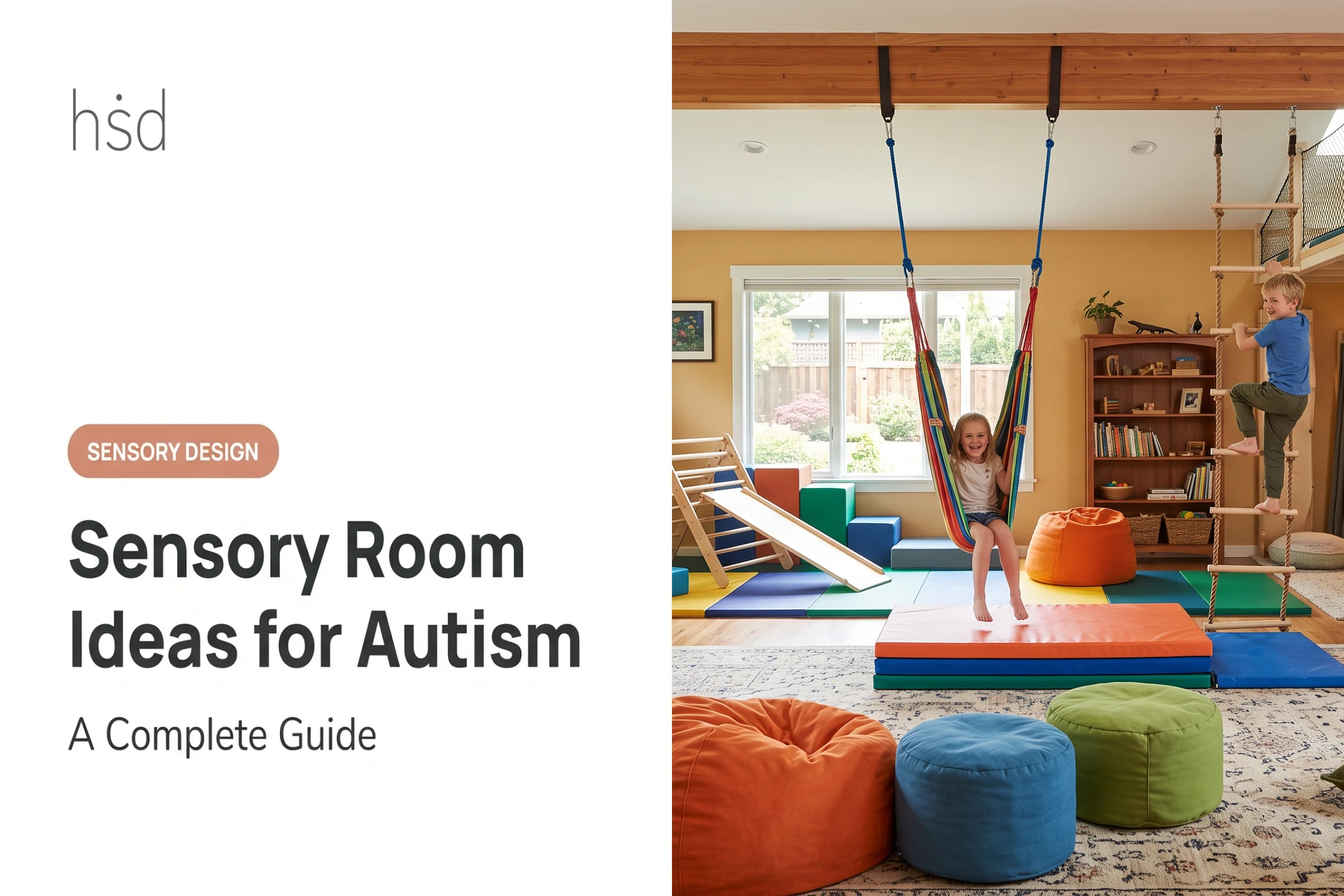

Common struggles include bright or flickering light, unpredictable household noise, scratchy fabrics, visual clutter, temperature swings, and a bedtime transition that feels abrupt rather than predictable. About 90% of autistic people report atypical sensory experiences, spanning both heightened and reduced sensitivity across touch, sound, and sight, according to a 2020 review in Frontiers in Integrative Neuroscience. That range means no two bedrooms should look alike.
This guide walks through identifying a person's sensory profile, choosing ideas by type of input, testing changes safely, and knowing when to bring in outside design support.
Key Takeaways
- Build the room around the individual's sensory profile, communication style, routines, and age, not a standard sensory-room template.
- Remove unwanted input first (glare, clutter, scratchy fabrics), then add optional supports: movement, pressure, or visual tools.
- Keep every feature easy to control or switch off so the person stays in charge and the space never feels clinical.
- Change one thing at a time and loop in an occupational therapist for complex needs.
Start With the Person, Not a Checklist
Autism doesn't produce a single sensory profile. One person may cover their ears at the hum of a fan while actively craving deep pressure or repetitive movement. Another might barely notice noise but find certain textures unbearable.
A multi-site analysis found that 74% of children showed hyper-reactivity, hypo-reactivity, or sensory-seeking behavior in at least one sensory domain, often across auditory, visual, and tactile channels at once. Research from the Autism Sensory Research Consortium confirms these patterns rarely fit neatly into one category.

Run a Simple Sensory Audit
Before buying anything, walk through each domain with the person (or observe carefully if they're non-speaking):
- Sight — glare, clutter, flickering bulbs, screen light
- Sound — HVAC hum, sibling noise, sudden alarms
- Touch — bedding texture, tags, pajama seams
- Smell — laundry detergent, paint fumes, plug-in fresheners
- Temperature — too warm under blankets, drafty windows
- Movement and body awareness — need to rock, pace, or press against something
- Transitions — how bedtime starts and how the room signals "wind down"
Ask directly what feels comforting, irritating, neutral, or unpredictable. For non-speaking individuals, use AAC, choice boards, or preferred communication tools. Autism Speaks notes that AAC benefits autistic people across the age spectrum, not just young children learning to talk.
Read the Signals, Not the "Behavior"
Covering ears, rocking, pacing, humming, or suddenly leaving the room often communicates sensory overload rather than defiance. Keep a short running list: helps, doesn't help, try carefully. Preferences shift with age, illness, stress, and fatigue, so revisit the list rather than treating it as fixed.
Autonomy matters here. The person should help choose the room's features whenever possible. Sensory tools are not meant to suppress harmless stimming or function as forced exposure. They exist to support the person's own regulation strategies.
Sensory Bedroom Ideas by Type of Input
Not every idea below belongs in every bedroom. Pick what matches the sensory profile you just mapped out, and skip the rest.
Sight and Visual Environment
Light sensitivity varies wildly between individuals. One 2025 systematic review found reported sensitivity ranging from under 7% to nearly 46% depending on the study population, with fluorescent flicker frequently linked to agitation, eye strain, and headaches. Common fixes include:
- Adjustable, indirect lighting instead of harsh overheads
- Blackout or light-filtering window coverings for those sensitive to brightness
- Reduced visual clutter with storage that keeps favorite items visible but contained
- Calm wall colors if the person prefers them (not a universal requirement) Some people enjoy a projector or color-changing light; others find moving light or glare overstimulating. Whatever visual feature you add, make sure it has an obvious, easy off-switch.
Sound and Auditory Control
Auditory sensitivity is common and well-documented. A 2022 scoping review found auditory hypersensitivity in 43% of Finnish children with ASD versus just 3% of children without ASD, with hyperacusis estimates in other samples running as high as 60–69%. Start by reducing noise at the source:
- Weatherstrip doors and windows to dampen hallway sound
- Add soft furnishings (rugs, curtains) to absorb echo
- Relocate noisy devices like routers or humming electronics
- Offer headphones, ear defenders, or a steady sound source only if the person finds them helpful Run a nighttime sound audit for HVAC systems, plumbing, appliances, traffic, and pets. One caution: any sound-masking tool should never prevent the person from hearing a smoke alarm or a caregiver's voice. The CPSC recommends alarms on every home level, including inside bedrooms, tested monthly with batteries replaced annually.
Touch, Bedding, and Clothing
Tactile sensitivity shows up constantly in bedroom design. A 2025 mixed-methods study of autistic adults found clothing-related hypersensitivity reported by 48.8% to 73.2% of participants, with tags, seams, and synthetic fabrics named as the most common triggers in research on tactile hypersensitivity in autistic adults. For the bedroom specifically, look at:
- Soft, breathable, tag-free, seam-conscious sheets
- Washable layers so texture can be adjusted night to night
- Mattress and pillow firmness matched to preference, not a "sensory-friendly" default
- Rug and upholstery textures tested in small samples before a full room overhaul
Pressure, Movement, and Stimming
Many autistic people rely on stimming to regulate. A 2019 interview study found autistic adults used stimming to reduce anxiety, manage overstimulation, and calm down, describing it as a self-regulating feedback loop rather than a behavior to eliminate (Journal of Autism and Developmental Disorders research). Design the room to allow safe stimming and movement:
- Body pillows or floor cushions for pressure-seeking
- Rocking seating or a dedicated open floor area for pacing
- Fidgets stored within reach, not tucked away
- Resistance bands used according to manufacturer guidance Safety matters with every tool here. Weighted blankets need individualized sizing and supervision. Rocking furniture should be checked for stability. Climbing or jumping equipment needs clear floor space and, where relevant, professional or manufacturer sign-off before use.
Smell, Temperature, and Air Quality
Indoor air quality affects everyone's comfort, and the American Academy of Pediatrics recommends reducing pollutant sources and improving ventilation in children's spaces. Keep scent-related choices flexible:
- Favor neutral or unscented products unless the person actively prefers a specific scent
- Ventilate well, since indoor VOC concentrations can run several times higher than outdoors
- Avoid heaters, humidifiers, or air fresheners layered in "just in case" — they can introduce new triggers or safety risks Never present scent as universally calming. What soothes one person may be the exact thing that overwhelms another.
Sleep and Transition Supports
Sleep disruption is common in autism. A 2022 review estimated that 40% to 83% of autistic individuals experience some form of sleep disturbance, according to research published in PMC. A predictable bedtime sequence can help:

- Set a consistent order: same steps, same sequence, every night
- Use a visual schedule: a single-child study found this improved bedtime-routine compliance
- Keep belongings in predictable spots: no last-minute searching for a comfort item
- Dim lights gradually rather than switching from bright to dark instantly
- Create a low-demand decompression area separate from daytime stimulating equipment Keep daytime regulation tools (bouncy seating, bright sensory lights) separate from the sleep environment itself, so winding down doesn't compete with activating input.
Turn Ideas Into a Safe, Usable Bedroom
Good ideas still need a safe layout. Start with the basics:
- Preserve a clear path to the bed and door
- Leave enough open floor space for pacing, rocking, or preferred movement
- Avoid crowding the room with every sensory tool at once
- Anchor unstable furniture to the wall
Furniture tip-overs cause real injuries every year. The CPSC reports an estimated 22,500 Americans were treated in emergency departments for tip-over injuries annually between 2018 and 2020, with nearly 44% under age 18.
TVs alone were involved in 71% of child fatalities in incidents tracked since 2000. Anchoring dressers, bookshelves, and TVs isn't optional in any bedroom, autism or not.
Run a Control-and-Access Test
Place lights, sound controls, fidgets, communication tools, water, and comfort items where the person can reach them independently, when it's safe to do so. If they can't turn off their own light or reach a fidget without help, the room isn't offering real autonomy.
Test One Change at a Time
Adding five new features in one weekend makes it impossible to know what's actually helping. Instead:
- Remove or reduce one clear trigger (a flickering bulb, a scratchy comforter)
- Improve light control
- Adjust bedding
- Create predictable storage
- Add one sensory tool that matches a stated preference
Track observable effects over several days before adding the next change: settling time, sleep quality, distress signals, and willingness to enter the room. No single product treats autism or guarantees better sleep—watch what actually changes.

Reassess if the person avoids the room, becomes more distressed, sleeps worse, or can't control the input. Remove or modify the feature instead of expecting them to adapt to it.
When to Consider Personalized Design Support
Some projects go beyond swapping out bedding or adding a lamp. Professional input often makes sense when you are facing:
- Renovations or major lighting and acoustic changes
- Multiple household members with competing sensory needs
- Mobility considerations or safety concerns tied to a specific diagnosis
A neuroinclusive design consultation translates an individual's sensory profile and daily routines into concrete decisions: layout, materials, lighting, acoustics, storage, accessibility, and budget. Those choices are hard to lock in from a blog post alone.
This is where Highly Sensitive Design fits in. Founded by licensed architect Shell Li, AIA, after her own son's autism diagnosis, the Brooklyn-based firm offers:
- Sensory Environment Assessment: Reviews lighting, ventilation, temperature control, accessibility, and code compliance in the home
- Comprehensive Interior Design Consultation: Starts with a detailed survey and interview, then builds a personalized design language for the space
- 30-Minute Neurodivergent Design Consult ($250): Focuses on one immediate challenge, such as lighting or acoustics in a single room
- Design & Build add-on: Connects families with trusted affiliated contractors to carry a plan through construction
Design decisions draw on a multidisciplinary team that includes psychologists, therapists, toxicologists, and special education teachers.
Highly Sensitive Design currently works with clients within about a two-hour drive of New York City. Confirm current scope and availability directly before booking.
None of this replaces clinical care. Coordinate with the person's occupational therapist, healthcare providers, and caregivers, and involve the autistic person directly whenever possible. Good design supports regulation; it does not replace clinical care.
Frequently Asked Questions
What are some types of stimming that people with autism use?
Common examples include rocking, hand-flapping, pacing, humming, repeating words or sounds, rubbing certain textures, and using fidgets. Stimming is often self-regulating, so bedroom design should focus on safety and space for it rather than suppression.
What should you put in a sensory bedroom?
Contents should match the individual's sensory profile rather than a fixed list. That might include controllable lighting, comfortable tag-free bedding, sound-management tools, organized storage, open movement space, and whatever calming or stimulating items the person prefers.
Can a sensory bedroom help an autistic person sleep?
Reducing unwanted light, noise, tactile discomfort, clutter, and unpredictable transitions can support a better bedtime environment. Results vary by individual, though, and no bedroom setup guarantees improved sleep.
How do I find out what sensory needs an autistic person has?
Combine direct observation with questions asked through the person's preferred communication method, whether that's speech, AAC, or a choice board. Keep a simple trigger-and-support log, and involve an occupational therapist for more complex or unclear needs.
Are weighted blankets safe for autistic children and adults?
Safety depends on age, weight, and the ability to move freely. Skip weighted blankets under age 2, keep weight under about 10% of body weight, and make sure the person can remove it on their own. Follow manufacturer instructions and get professional advice before use.